

How To Draw A Grid In Processing
In this coding activity we volition employ the Processing library to create a filigree of coloured squares. Nosotros will utilize the Hue Saturation Brightness (HSB) color model to assign the colours, which I covered in a previous action. Consequently, this activity follows from previous ones and I advise y'all achieve those activities first:
- Setting up the programming environs,
- The activity to make a quick sketch before y'all code, and
- Hue Saturation Effulgence activities get-go.
- Create a spectrum of coloured squares in Processing (part i)
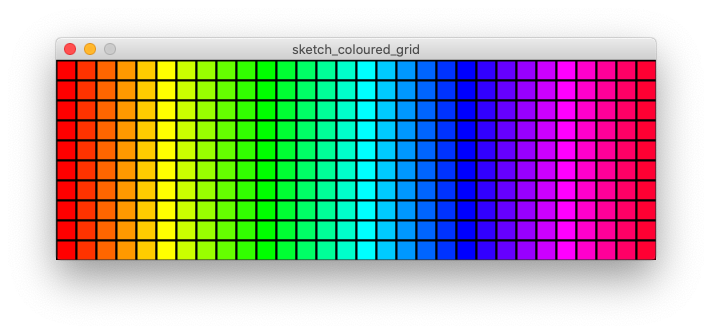
At the stop of this action, I want you to realise that (in coding) information technology is best to dissever the index (position) of each grid jail cell and its actual x,y plotted position. This makes lawmaking that tin be easily practical to different situations.
Stride 1. Plan the picture
Any project y'all are doing, information technology is good to know where you are heading! The Critical Thinking Sheet can help you think and programme your code.
Our activeness today is to create a moving-picture show of a grid of coloured shapes, where each square is placed alongside the other.
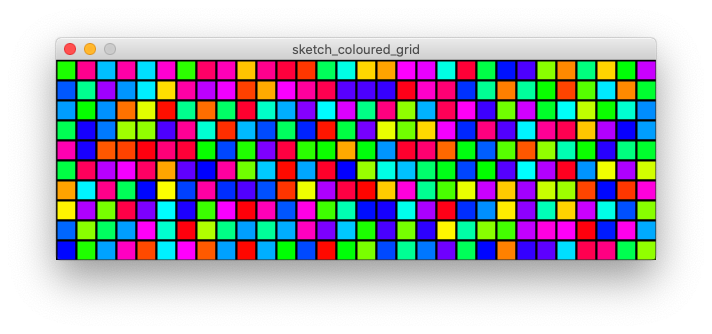
We can think nigh this idea as a grid of cells, where each cell is the same size, sits side by side to another cell, and each cell includes ane object. We could identify different shapes in each jail cell (such as a rectangle or a circle), but let's start by placing coloured squares. We could also change the colours of the circles to create various patterns, but let's start simple and shade them by random colours.
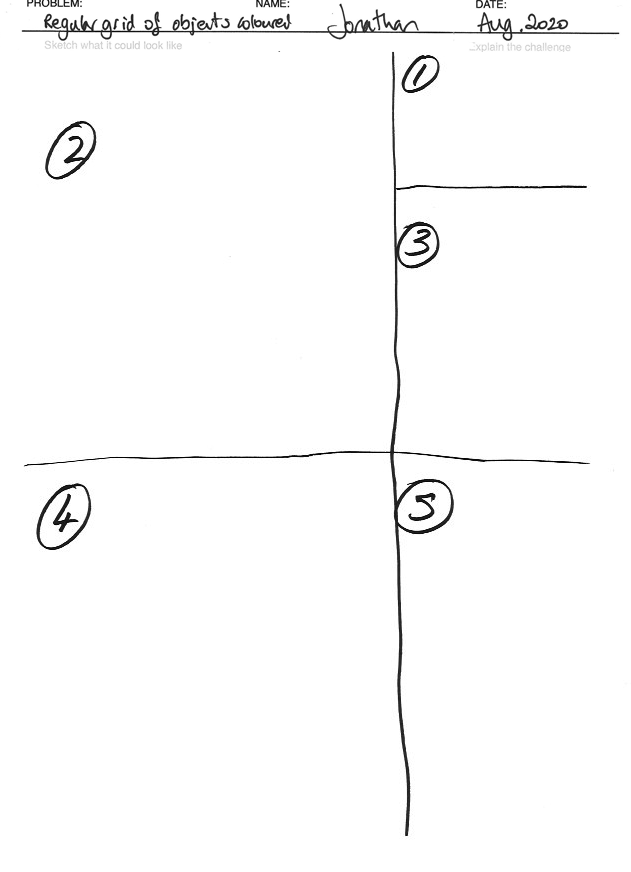
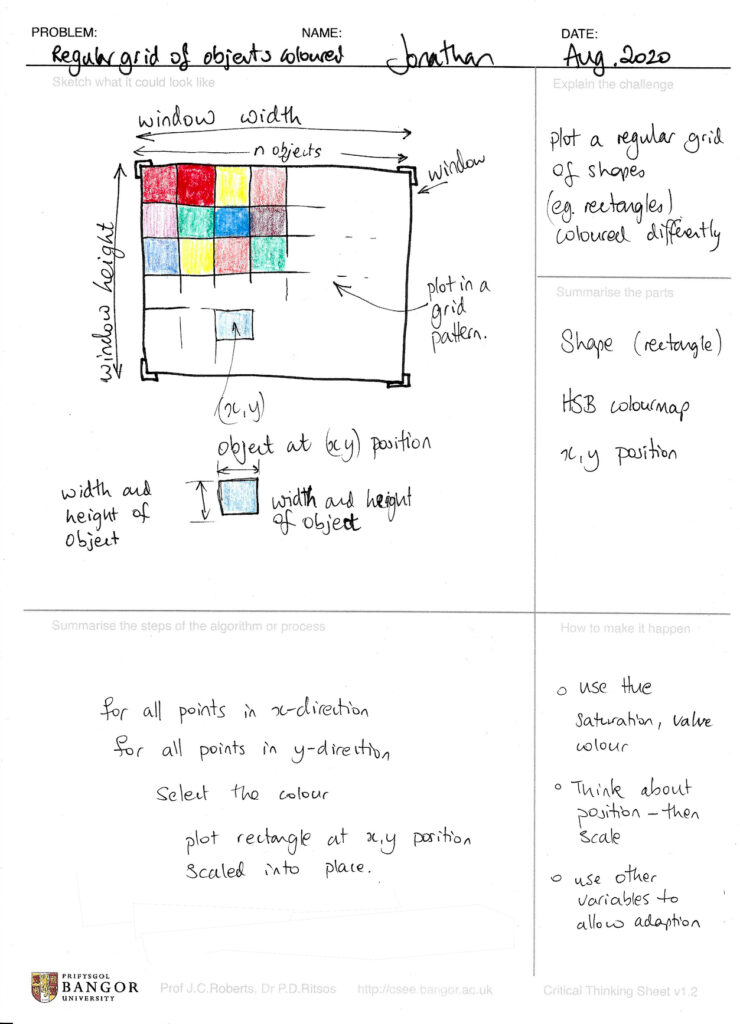
- If yous take not done then already: print out the Disquisitional Thinking Sail. On the printout, now complete the problem, name and add today'due south date. Likewise explicate the challenge part ①
- In panel ② make a sketch of the problem output, and annotate the diagram.
- In panel ③ y'all can explain the main components of the organisation. In this challenge at that place are three main aspects: (i) the shape that we will plot, (ii) the colour that it will be, and (iii) the position we will place it in.
- In panel ④ nosotros can now explain the procedure (algorithm). A simple process is to run through every cell position (we can do this by going through all x positions and and then all y positions), then set the required colour, and finally plot the shape.
- Finally, nosotros need to consider what to do next. Definitely we need to think more most the cell, and how to index each part, and nigh the colour model.
Step 2. Set up the basic window
Setting upward the Processing environment with basic code should piece of cake now.
- Set the window
sizeto 600 by 200 - Set
backgroundto white - Choose the
colorModeto be HSB, and set all values (for at present) to be 100 - Plot a grey rectangle, to make certain it all works fine.
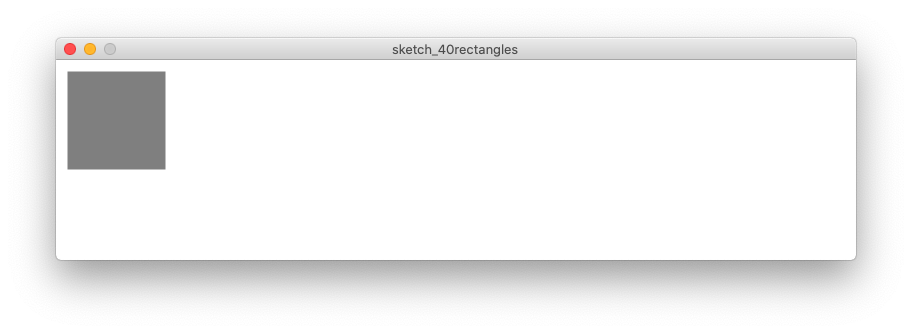
size(800,200);colorMode(HSB, 100, 100, 100);groundwork(100);// Do a test with ane rectangle// simply to brand sure that everything is workingfinemake full(l);stroke(100);strokeWeight(2);rect(x,x,100,100);
Stride 3. Understand the grid and coordinate arrangement
Permit united states of america remind ourselves about the coordinate organization in Processing.
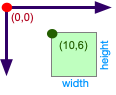
We can plot a rectangle in Processing, by describing the location of the pinnacle left position of the rectangle, and set its width and height.
Height Tip.
A unit of measurement square sets each side to exist ane.
Let united states assume (for now) that the width and peak of the rectangle is one. This provides a really squeamish way to alphabetize every grid point. The starting time square is placed at (0,0), and then moving to the right we get the second at (1,0), 3rd at (two,0) and and then on. We are using the unit of measurement square, to simplify the code.
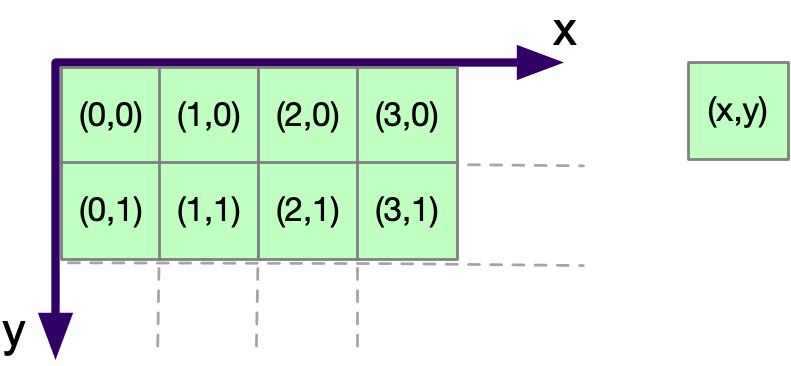
This indexing scheme fits really well with a for loop. For example we tin utilise two for loops to index positions in a 2D filigree betwixt 0 and 9 as follows:
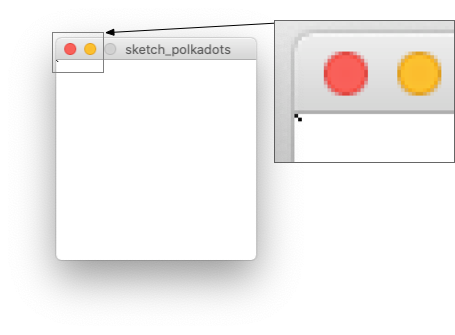
for(int x=0; 10<ten; x++) for(int y=0; y<x; y++){ // loop lawmaking goes here } Merely, if we directly plot 1 past 1 rectangles – they would be very small-scale. Indeed, so small that they are just revealed when nosotros zoom into the screenshot.
Nosotros need to scale everything upward. In computer graphics scaling is performed through multiplication. So to scale everything by 10, nosotros can multiple the index position x and y past 10 to become the real location, and multiple the unit rectangle past 10, to create a rectangle of 10 width by 10 height. Mayhap nosotros want a grid of 12 rectangles by 12 rectangles, we merely change the terminate conditions of both for-loop to 12. Equally follows:
for(int x=0; x<12; x++) for(int y=0; y<12; y++){ rect( 10 * 10, y * 10, 10, ten); } Top Tip.
Separate the quantity of items, and how they are indexed, from their utilize.
This is a really good strategy: separate the quantity of the things, and how they are indexed, from their utilise (or in our case, their position).
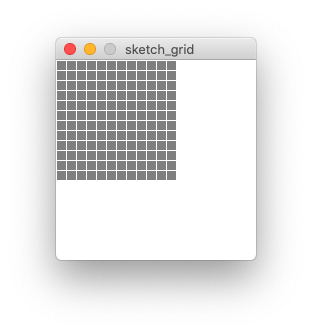
Refactor the code.
Let us improve the code making it more descriptive, and remove magic numbers. To do this nosotros need to define some variables.
- We can prepare
myScaleto exist 10, - the
widthandheightof each rectangle to existcellSize, - the size of the index could be unlike in 10 and the Y management, then let'due south ascertain
gridQuantity10 and gridQuantityY too to ten. The code to accomplish this result is as follows:
size(200,200); colorMode(HSB, 100, 100, 100); background(100); fill(l); stroke(100); strokeWeight(1); float myScale = 10; float cellSize = 10; int gridQuantityX = 12; int gridQuantityY = 12; for(int x=0; x<gridQuantityX; x++) for(int y=0; y<gridQuantityY; y++){ rect( x * myScale, y * myScale, cellSize, cellSize); } Some observations with this code:
- if
cellSizeis bigger thanmyScalethen the rectangles overlap, - if
cellSizeis smaller and somyScalein that location is a small gap between each rectangle. - if the result of
gridQuantityX*cellSizeis larger than the width orgridQuantityY*cellSizegreater than the width of the window then not all the rectangles would be seen on that window.
Step 5. Colour the squares and brand the grid make full the window
Let's modify the code (slightly) to make the grid make full the window. Nosotros can practice this by setting the rectangle dimensions, and calculating the quantity of rectangles that will fit in the window. We also need to re-organise the lawmaking lodge to brand information technology piece of work; especially set up the colorMode subsequently, when we know the colour range.
Top Tip.
Remember to refactor your code.
- fix the
cellSizeto20 - Summate the (integer) quantity of cells that will fit in the window width, past
floor(width/cellSize); - Calculate the (integer) quantity of cells that will fit in the window height, by
floor(height/cellSize); - Set the scale to the
cellSize. - Fix the colourRange in the HSB space to the
xvalue of the gridQuantity; - Fill the colour based on the
tenvalue.
size(600,200); background(255); float cellSize = ten; int gridQuantityX = floor(width/cellSize); int gridQuantityY = floor(peak/cellSize); bladder myScale = cellSize; int colourRange = gridQuantityX; colorMode(HSB, colourRange, 100, 100); stroke(0); // get in black strokeWeight(ii); for(int x=0; x<gridQuantityX; 10++) for(int y=0; y<gridQuantityY; y++){ fill(x,100,100); rect( x * myScale, y * myScale, cellSize, cellSize); } 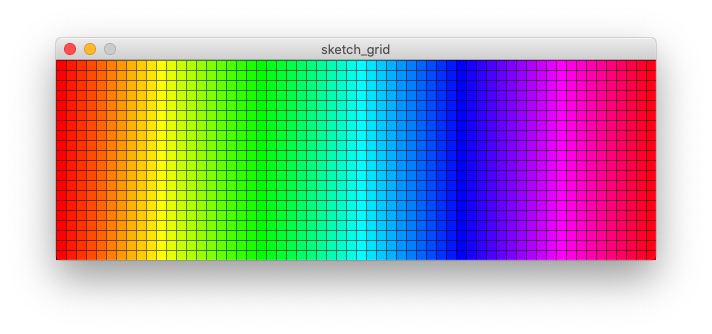
Step 6. Now your turn. Add variation and try different values
Now we can change the bones code, to make it more interesting.
Try dissimilar colour combinations. Perhaps make them all ane colour, random colours, or a small range of colours (such as low-cal bluish to dark blue.
Meridian Tip.
Don't guess values for your code. Instead imagine the end result, then choose values to achieve that consequence!
Adapt the size of the rectangles. Attempt to brand them bigger or smaller. Even brand them really pocket-size, so that individually the rectangles cannot exist seen.
Alter the stroke and appearance of each rectangle. White strokes, coloured stroke, blackness stroke, to noStroke.
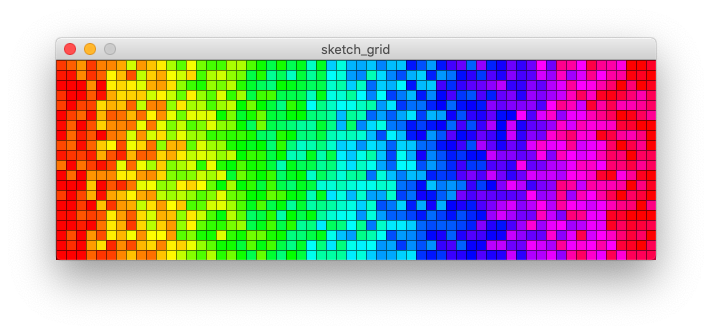
Add some noise. One thing we could add together some randomness into the colour choice. Rather than plotting an exact colour, we can add or delete a random value from a fixed colour blueish. We are adding a deterministic jitter to the colour value. We tin hands achieve this past adding a random value to the colour. For instance, we can use a random range created past random(-5,5). By choosing a stock-still colour bluish, nosotros can make a swimming puddle tiling pattern, as follows:
Nosotros tin can do the same with the spectrum colour choice: choose the spectrum colour, then jitter the colour by +random(-5,5).

Source: https://csee.bangor.ac.uk/project-rainbow/create-a-coloured-grid-in-processing/
Posted by: wilsonevembee.blogspot.com
0 Response to "How To Draw A Grid In Processing"
Post a Comment